







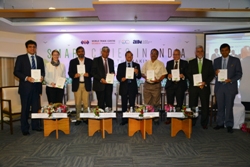
 New Delhi, Jan 2015: “The exciting times that we are living in are transformational in nature for India. We can all perform wonderfully well under the present government which is focused in its goals to provide meaningful and inclusive growth. This can be achieved when the 22 percent of the population that is below the poverty line, the 50 percent below the empowerment line and the disadvantaged are included in such growth. This has brought us to the juncture to relook at the urbanization process, since growth and in turn employment is generated from the urban sector”, said Shri Shankar Aggarwal (IAS) Secretary, Ministry of urban Development, Government of India, who delivered the keynote address at interactive panel discussion on ‘Smart Cities in India: Reality in the Making’ jointly organized by MVIRDC World Trade Centre and All India Association of Industries along with the Indo-French Chamber of Commerce & Industry.
While addressing how 100 Smart Cities initiative came about, Shri Aggarwal said that the process started with the Swachh Bharat Abhiyan, to rejuvenating heritage towns, bringing about urban renewal of 500 towns leading to creation of the 100 smart cities. He highlighted that Indians were basically entrepreneurial by nature. India possessed demographic dividend and the urban population of 31 per cent contributes to 63 per cent of GDP. It is education that would bring about empowerment; however the quality of education is poor which can be fixed through the right infrastructure such as e-education, imparting good quality skills. Each step of the process can be made sustainable and frugal innovation can be introduced in every area which then can be supported by governments and semi-government bodies.
 Shri Aggarwal advocated that national priorities could be made a reality through technology, innovation, citizen involvement, employment generation through ‘Make in India’ while improving the quality of life. In order to bring about the smart cities concept, it is important to introduce competition among cities through the Bloomberg Philanthropy whereby funding solution to urban challenges could be reached. Assuring to set up 100 cities in a span of 10 years, Shri Aggarwal was supportive towards adding to the existing strength of the people, providing the necessary hand holding in seeing projects through and being a facilitator in the entire process.
Dr. Laveesh Bhandari, Founder and Chief Economist, Indicus Analytics Pvt Ltd.the moderator of the panel discussion while introducing the panelists showed skepticism in the policy making and sustainability issues in creating smart cities.
Mr. Sanjay Sethi (IAS). Additional Metropolitan Commissioner-I, Mumbai Metropolitan Region Development Authority (MMRDA) while attempting to define the smart city concept said that the right definition would emphasize the process of creating a smart city and not the final product. Providing a case study on the Bandra-Kurla Complex (BKC) in making it a Brownfield Smart City Project, he said that they were achieving it through the use of ICT and non ICT initiatives coupled with the right urban design. Besides, the formation is based on foundational, advanced and futuristic initiative which is the way forward. Smart BKC was being built around centricity, business and making it environment friendly through the process of continuous innovation. It was being conceptualized in comparison to global cities. In a similar way, Smart Wadala Greenfield project was being conceptualized to include mixed land use, smart transport, pedestrian segregation, green buildings, intelligent buildings and smart physical infrastructure.
Mr. Abhishek Lodha, Managing Director, Lodha Group brought in the aspect of the private sector in the creation of smart cities. He opined that some of the most livable cities across that world have incorporated the various smart elements to improve the quality of life for its citizens. Smart Cities need to become smarter in multiple domains across governance, sustainability while improving overall quality of life of its citizens he added. Citing the example of Palava, a project involving an initial investment of Rs. 30,000 crore, he said that the project was exemplifying the smart city opportunity with numerous initiatives being rolled out.
Earlier in the welcome address, Mr. Vijay Kalantri, Vice Chairman, MVIRDC World Trade Centre and President, All India Association of Industries, while stressing on the need for infrastructure in order to create smart cities he said that the Honorable Prime Minister Shri Narendra Modi announced the 100 Smart initiative which has opened up a plethora of opportunities as well as challenges necessitating some innovative approaches and measures. Although a vision to make Smart Citiesy was in place, he stressed the need to frame policies for the implementation process while also making the people involved accountable.CCI Newswire